Salem's tree canopy creates a two-season debris problem that most homeowners only notice once. Big-leaf maples drop wide, heavy clusters from October through December, and Douglas firs shed needles and small cones from…
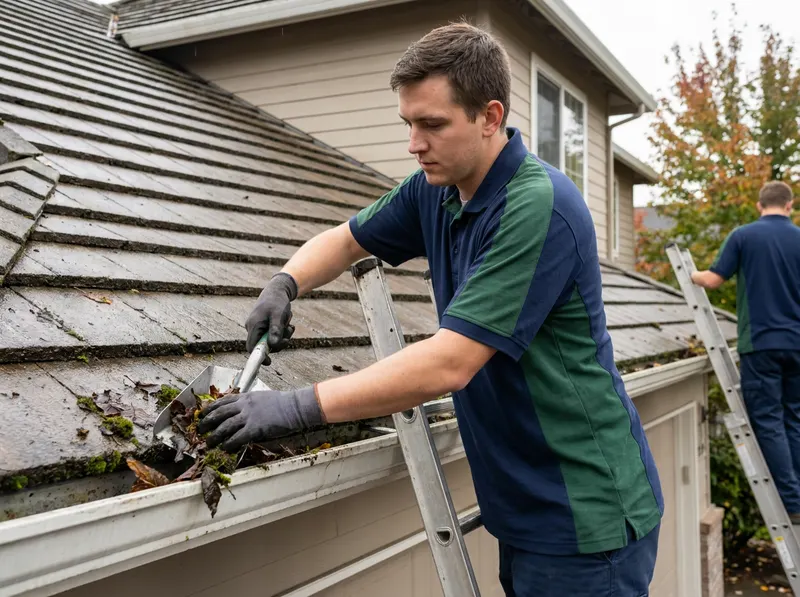
Salem's tree canopy creates a two-season debris problem that most homeowners only notice once. Big-leaf maples drop wide, heavy clusters from October through December, and Douglas firs shed needles and small cones from late summer through February, meaning debris accumulates across nine months, not just fall. aspx'>Morningside and Englewood, where mature canopy trees overhang roof ridges by 10 to 20 feet, roof valleys can accumulate a 2, 4 inch compressed mat of organic matter within a single wet season.
The distinction between roof edge clearing and standard gutter cleaning matters for a specific reason: debris sitting on the roof surface above the gutter constantly reloads the trough. A gutter flushed in October but left with a packed valley above it can be half-blocked again by Thanksgiving after a single wind event. aspx'>Marion County's average annual rainfall is approximately 40 inches, with the heaviest precipitation concentrated between November and March, the same window when valleys are most likely to be carrying standing debris.
Clearing the roof edge and valley before that window closes means the gutter system can actually perform as designed across the full storm season, not just the week after a cleaning.
The service fits best when a homeowner notices overflow staining on the fascia board, water sheeting off the roof edge rather than entering the gutter, or visible dark streaking on the shingles near the valley line, all observable signs that the roof surface itself, not just the trough, is part of the drainage problem. gov/green-infrastructure/managing-wet-weather-green-infrastructure'>standing-water path that bypasses the gutter entirely and runs directly down the exterior wall can deposit water at the foundation in 45 minutes during a heavy rain event.
Roof edge clearing removes the upstream cause. For homes in West Salem and Sunnyslope with steeper pitches, common in mid-century construction along the Brush College Road corridor, valley debris tends to slide toward the lower edge and compress into the gutter entry point, so clearing both the valley and the trough entry in a single visit is the standard approach.
After the roof surface is cleared, the team photographs the valley and edge condition and texts the images directly to the homeowner, showing the debris volume removed and the current state of the flashing and shingle edges.
If granule loss, lifted shingles, or cracked valley flashing is visible, that observation is noted in plain language in the written summary: what was seen, where it is located, and what it typically means, with no repair pressure attached. org/'>decision on next steps stays with the homeowner. Fernline Gutter Cleaning does not perform roofing repairs; the summary is informational so the homeowner has documented evidence if they choose to contact a licensed roofer.
This approach matters in South Salem and Faye Wright neighborhoods, where homes built in the 1960s, 1980s often have original valley flashing that has never been visually assessed from roof level. Scheduling is available Monday through Saturday; same-day appointments depend on route availability.
Every job gets a firm, written price after a free on-site visit.
For standards, safe disposal, and service guidance on Gutter Cleaning in Salem, OR, useful references include U.S. Dept. of Energy, ENERGY STAR, HUD, OSHA, U.S. Green Building Council, and Google Maps. General consumer and small-business resources are available from USA.gov, Better Business Bureau, FTC Consumer Advice, U.S. Small Business Administration, and Ready.gov.
Tell us about your roof edge & valley debris removal job in Salem and we'll send a clear, written quote, usually the same day.
 Fernline Gutter Cleaning